
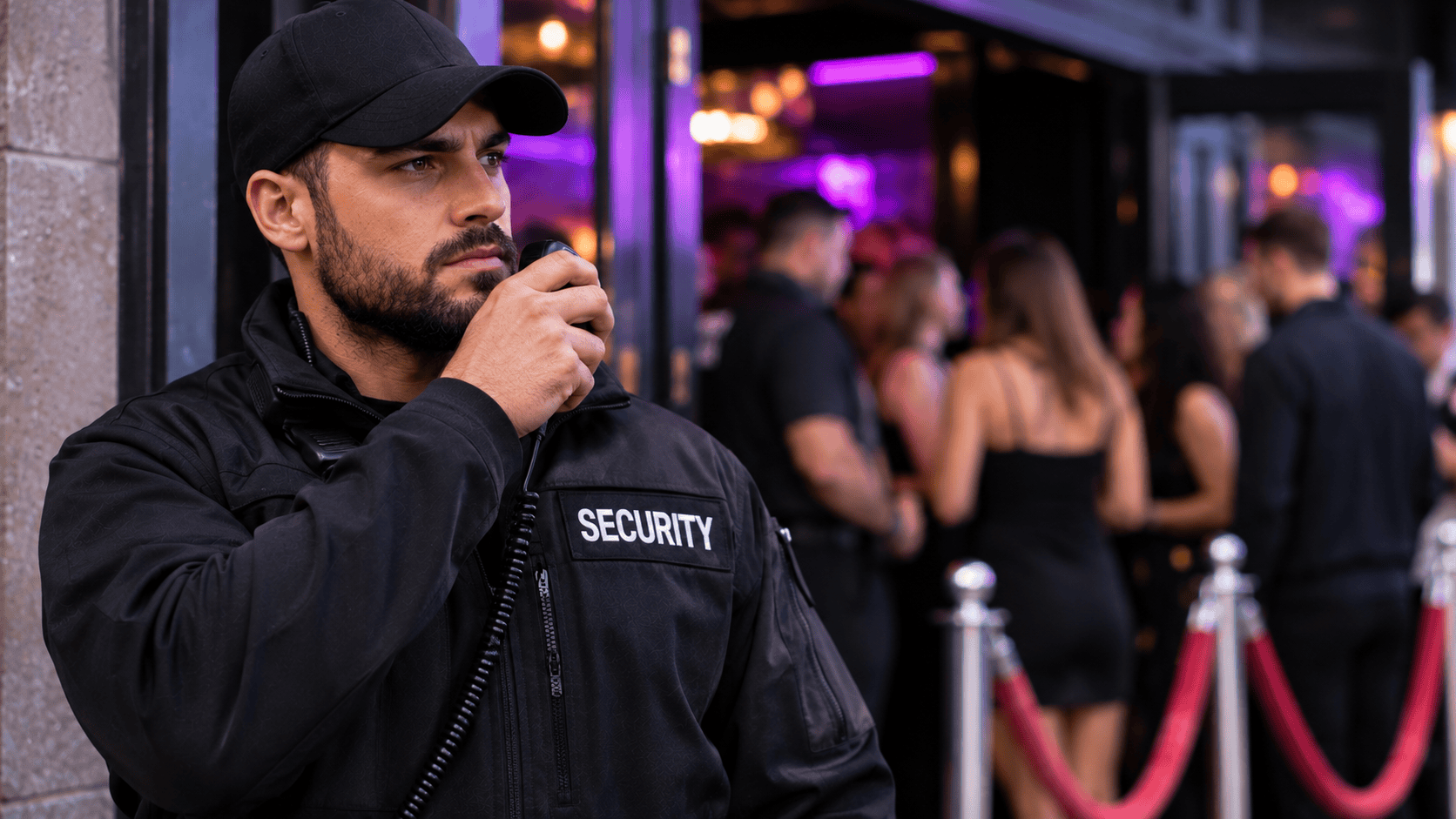
Removing a Patron: When Does Force Become Excessive? What Ontario Security Guards Should Know
Last Updated on Nov 16, 2026
Security guards working in Ontario’s nightclubs, entertainment venues, hospitals, and retail establishments regularly encounter individuals who refuse to leave private property when directed.
While many situations can be resolved through communication, others may escalate into verbal confrontations or physical resistance. Alcohol, drugs, mental illness, and heightened emotions can all influence an individual’s behaviour.
For security professionals, these encounters require quick thinking, sound judgment, and a clear understanding of their legal responsibilities.
At Ontario Guard Training, we recognize that understanding legal authority and appropriate intervention is an important foundation for anyone pursuing a career in security.
In some circumstances, physically removing someone from a property may be necessary. However, having the authority to remove an individual does not mean that any level of force is acceptable.
So, when does reasonable force become excessive?
An August 2026 incident at a Winnipeg nightclub raises important questions about the legal authority of security guards, the importance of communication, and the consequences of physical interventions that may cross legal boundaries.
Although the incident occurred in Manitoba, its lessons are equally relevant to security professionals working throughout Ontario.
The Incident: Three Security Guards Charged
At approximately 1 a.m. on August 3, 2026, Winnipeg police responded to a disturbance at a nightclub in the 400 block of Main Street.
According to police, a 28-year-old patron had been involved in an altercation with security personnel and required hospital treatment for his injuries.
The patron was later identified as Teddy Allen, a professional basketball player with the Winnipeg Sea Bears.
According to news reports, video footage taken inside the nightclub shows Allen being forcefully removed by at least three security guards.
On August 12, three security guards were arrested and charged with assault causing bodily harm.
It is important to emphasize that criminal charges are allegations, not findings of guilt. The available reporting also does not provide a complete account of the events leading up to, during, or following the confrontation.
Nevertheless, the incident provides an opportunity to examine how security guards should approach similar situations and why understanding the limits of legal authority is essential.
Understanding a Security Guard’s Authority in Ontario
Security guards in Ontario are often responsible for enforcing property rules on behalf of business owners, property managers, and other authorized individuals.
For example, a nightclub manager may decide that an intoxicated patron must leave because of aggressive or disruptive behaviour.
Security personnel may then be directed to communicate that decision and ensure the individual leaves the premises.
When the patron cooperates, the situation can often be resolved without further intervention.
However, when someone refuses to leave, security guards must understand which legal authorities apply and what actions are permitted.
Ontario’s Trespass to Property Act
Ontario’s Trespass to Property Act establishes rules governing unauthorized access to private property and certain other premises.
Under the legislation, property owners and authorized representatives can prohibit individuals from entering or remaining on their property.
Notice may be provided verbally, in writing, or through signs or markings, depending on the circumstances.
For example, a security guard working at a shopping centre may be instructed to advise an individual that they are no longer permitted on the premises.
If that individual refuses to leave after being directed to do so, they may be committing an offence under the Act.
Section 9 of Ontario’s Trespass to Property Act permits a police officer, occupier, or person authorized by the occupier to arrest an individual without a warrant when there are reasonable and probable grounds to believe the individual is on the premises in contravention of the Act.
A security guard acting under the property owner’s authority may therefore have the power to arrest in qualifying circumstances.
However, when someone other than a police officer arrests this provision, they must promptly call for police assistance and deliver the arrested individual to a police officer.
For Ontario security guards, understanding these responsibilities is essential.
The authority to arrest someone for trespassing is not the same as having unlimited authority to use force.
Security personnel must distinguish between their arrest powers, their authority to remove individuals, and the legal restrictions governing physical interventions.
Criminal Code Section 35: Defence of Property
In addition to Ontario’s provincial trespassing legislation, security guards must understand the protections and limitations established by the Criminal Code of Canada.
Section 35 of the Criminal Code addresses the defence of property.
Generally speaking, the section allows individuals in peaceable possession of property, or those acting under their authority, to take reasonable action to protect that property.
This may apply when someone enters a property without legal authority, interferes with property, or refuses to leave after being directed to do so.
However, the law requires that the actions taken be reasonable in the circumstances.
Having the authority to remove someone does not automatically make every method of removal lawful.
In the Winnipeg nightclub incident, the manner in which the guards removed Teddy Allen has been called into question.
The situation demonstrates why security professionals must distinguish between having the authority to act and ensuring that their actions remain legally justified.
Reasonable Force: Understanding the Limits
When a confrontation becomes physical, security guards must continually assess whether their response is appropriate to the situation.
The National Use of Force Framework provides a conceptual approach to assessing situations and selecting appropriate responses.
Although the framework was developed for policing, its principles can also support decision-making in private security.
It is important to recognize that the framework is not legislation and does not independently authorize the use of force.
Instead, it helps professionals consider factors such as:
- The individual’s behaviour and level of resistance.
- The surrounding environment and potential hazards.
- The seriousness and immediacy of any threat.
- The availability of assistance or alternative responses.
- Changes in the individual’s behaviour throughout the incident.
Security situations are rarely static.
For example, a patron who initially refuses to leave may become cooperative after receiving clear instructions. Alternatively, an individual who was cooperating may suddenly become aggressive.
As circumstances change, the response must change accordingly.
The key principle is that any force used must remain reasonable and legally justified.
Once the threat has ended or the objective has been achieved, continued force may no longer be justified.
Communication: The First Step Toward De-escalation
Many security incidents begin with a simple verbal interaction.
A security guard approaches someone, explains that they must leave the premises, and requests their cooperation.
However, being asked to leave can trigger feelings of embarrassment, frustration, anger, or fear.
These emotions may cause the individual to argue, refuse instructions, or become confrontational.
The way a security guard communicates can have a significant influence on how the situation develops.
Maintaining a calm but directive tone, explaining expectations clearly, and allowing the individual an opportunity to comply can help prevent unnecessary escalation.
One effective strategy is the Refusal Approach.
The Refusal Approach
1. Ask Again
Clearly repeat the request.
“I would like you to leave the club.”
2. Reason
Explain why the individual is being asked to leave.
“When you pushed our server, you violated our violence and harassment policy.”
3. Benefits
Explain the advantages of cooperating.
“If you leave on your own, there won’t be a scene, and you’re welcome to come back another night.”
4. Options
Explain the lawful options available if the individual refuses.
“If you refuse to leave, we may need to escort you out or request police assistance.”
5. Confirmation
Confirm that the individual understands the request and provide an opportunity to comply.
6. Action
Follow through with the appropriate response based on the individual’s behaviour and the available legal authorities.
If the individual agrees to leave, allow them to do so voluntarily.
If they refuse, reassess the situation and determine the safest lawful response.
This structured approach helps security personnel maintain control of the interaction while giving the individual opportunities to cooperate.
While communication cannot prevent every physical confrontation, it remains one of the most important tools available to security professionals.
Team Intervention and Individual Accountability
The Winnipeg nightclub incident involved multiple security guards participating in the removal of Teddy Allen.
In potentially violent situations, a coordinated team response can improve safety for security personnel, patrons, and bystanders.
However, effective teamwork requires more than simply having several guards involved.
Each member of the team must understand their role, communicate effectively, and work toward the same objective.
Without coordination, a physical intervention can quickly become chaotic.
Training helps security professionals understand how to respond as a team while maintaining appropriate control over their individual actions.
It is equally important to recognize that each security guard remains responsible for their own conduct, even when acting as part of a team.
The fact that multiple guards are involved does not remove individual accountability.
In the Winnipeg incident, three security guards were charged in connection with the confrontation. The legal process will determine the outcome of those allegations.
For Ontario security professionals, the incident reinforces the importance of coordinated responses, clearly defined responsibilities, and ongoing training.
Key Lessons for Ontario Security Guards
The Winnipeg incident highlights several lessons that apply to security professionals working throughout Ontario.
1. Understand Your Legal Authority
Security guards must know the difference between enforcing property rules, removing individuals, and making arrests.
Ontario’s Trespass to Property Act and the Criminal Code establish different legal authorities that must be understood and applied appropriately.
2. Prioritize Communication
Physical intervention should be considered only when necessary and legally justified.
Clear instructions, patience, and effective de-escalation strategies can often prevent confrontations from becoming physical.
3. Work Together Effectively
When multiple guards are involved, clearly defined roles and coordinated communication help maintain safety.
Every team member must understand their responsibilities and remain accountable for their actions.
4. Continuously Assess the Situation
An individual’s behaviour can change rapidly.
Security guards must continually evaluate whether their response remains appropriate and adjust their actions as circumstances evolve.
5. Recognize the Consequences of Excessive Force
Using force that is not legally justified can have serious consequences, including:
- Criminal charges.
- Civil liability.
- Loss of employment.
- Licensing consequences.
- Physical injuries.
- Damage to professional reputation.
Understanding these risks is an important part of working responsibly in Ontario’s security industry.
Why Proper Security Guard Training Matters in Ontario
Security guards working in Ontario encounter a wide variety of situations that require professionalism, sound judgment, and an understanding of legal responsibilities.
From managing disruptive patrons at entertainment venues to enforcing access restrictions at commercial properties, security personnel must be prepared to respond appropriately.
Quality security guard training provides a foundation in important areas such as legal authorities, communication, conflict management, and professional conduct.
In Ontario, individuals pursuing a security guard licence must complete the required basic training and meet the province’s licensing requirements.
However, learning should not stop once a security guard receives their licence.
Ongoing professional development helps guards strengthen their decision-making skills and better prepare for challenging situations.
The Winnipeg nightclub incident demonstrates how quickly a physical confrontation can lead to serious legal consequences.
It also reinforces an important principle: effective security is not about using the greatest amount of force possible. It is about understanding when intervention is necessary and ensuring that every action remains reasonable, professional, and lawful.
At Ontario Guard Training, we understand the importance of preparing security professionals for the responsibilities that come with working in the industry.
Whether you’re just beginning your career or looking to strengthen your professional knowledge, developing a solid understanding of legal authorities, communication, and conflict management is an important step toward becoming a confident, capable security guard.
Ready to take the next step in your security career?
Visit OntarioGuardTraining.ca to explore our security guard training opportunities and get started.
References
Canadian Association of Chiefs of Police. (2000). A national use of force framework.
https://www.cacp.ca/_Library/resources/National_Use_of_Force_Framework.pdf
Criminal Code, R.S.C. 1985, c. C-46, ss. 26, 34, 35.
https://laws-lois.justice.gc.ca/eng/acts/C-46/
Government of Ontario. (1990). Trespass to Property Act, R.S.O. 1990, c. T.21.
https://www.ontario.ca/laws/statute/90t21
Government of Manitoba. (1987). The Trespass Act, C.C.S.M. c. T156.
https://web2.gov.mb.ca/laws/statutes/ccsm/t156.php
Patterson, K. (2026, August 13). 3 security guards facing assault charges after Winnipeg Sea Bears’ Teddy Allen injured. CityNews Winnipeg.
https://winnipeg.citynews.ca/2026/08/13/teddy-allen-injury-security-guards-assault/
Winnipeg Police Service. (2026, August 13). Assault investigation at licensed premise results in charges: C26-191112. City of Winnipeg.
https://www.winnipeg.ca/police/community/news-releases/2026-08-13-assault-investigation-licensed-premise-results-charges-c26-191112